This morning, instead of starting chapter 6 of my current novel, I'm revising a query letter for my finished novel which I'm marketing to agents and small presses. I've used the same query template for the past couple years, and I felt like it needed to read more contemporary more to today's standards of query presentation.
For some query enlightenment I browsed over to my old friend Query Shark. Query Shark is a working agent's blog to which writers submit real query letters. QS critiques certain ones, giving the poop, the scoop, and the 411 about what she loves, hates, and needs in a query. For writers at the getting-a-book-published stage, her advice (I think it's a her) is essential.
I trolled through the critiques and came across this great piece of query writing advice from the mighty shark herself, which concisely explains what a query should do:
"I think of queries as a bit like what figure skaters used to have to do in the Olympics: compulsory figures. Skaters were required to perform a series of figures, and were judged solely on accuracy not artistry. There is a photo somewhere of a judge measuring a line in the ice with a ruler!
The resemblance of queries to compulsories is this: you have to get the basics down in the query. Your artistry shows in your pages. Yes your voice comes through in your query. Yes there is style there. But mostly you've got to communicate some basic info: what the book is about, and the stakes involved."
Word.
Showing posts with label fiction. Show all posts
Showing posts with label fiction. Show all posts
Saturday, April 3, 2010

Sunday, January 24, 2010
An Evening with Randy Susan Meyers

An excellent time was had by all who gathered this past Thursday at Bella Luna restaurant in Jamaica Plain to see Randy Susan Meyers read from and sign her brand-spanking new hardcover The Murderer’s Daughters.

The back room of Bella Luna (the Milky Way) was packed with well wishers, friends, family, and fellow writers. Jenna Blum was on hand to introduce Randy to the crowd. Randy read a riveting section of her book, which is about two girls, Lulu and Merry, who witness the murder of their mother at the hands of their father.
 After the reading, Randy signed copies of her book available for sale on-site courtesy of Newtonville Books. Not only that, all proceeds of the evening's book sales were donated to The Home for Little Wanderers' Harrington House.
A collection of some of the foreign covers for The Murderer's Daughters:

Proud book owner:

Many writers were spotted throughout the night, including Chris Abouzeid, Christiane Alsop, Nichole Bernier, Cecile Corona, Kathy Crowley, Ginny DeLuca, Stephanie Ebbert, Chuck Garabedian, Andrew Goldstein, Iris Gomez, Leslie Greffenius, Eric Grunwald, Javed Jahangir, EB Moore, Henriette Lazaridis Power, and Becky Tuch.
Here I am, chatting up a few lovely ladies of lit, including Stephanie Ebbert, Agent Stéphanie Abou, Jenna Blum, and Henriette Lazaridis Power:

It was a successful evening, and a great kick-off for Randy and The Murderer's Daughters.
 Special thanks to Liz for being my personal photographer for the evening.
Sunday, January 10, 2010
MIA: New Yorker's Winter Fiction Issue
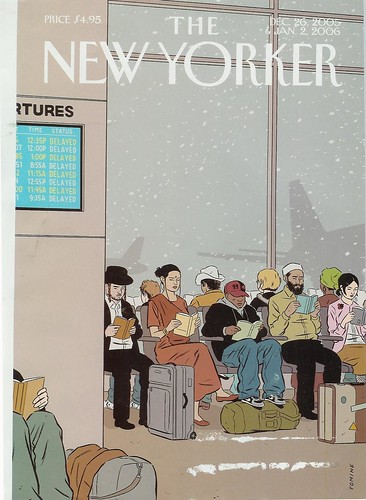
I'm always interested in the fiction published in The New Yorker. Although I generally don't buy the New Yorker. It's a weekly! I can't be expected to keep up that kind of reading pace. But, there are historically two New Yorker issues that I'll buy without provocation: the summer and winter fiction issues. Two over-sized issues devoted to fiction. Ahhhh.
So imagine me standing around the Barnes & Noble stacks last month in a fugue of holiday shopping overstimulation, staring at the spine of the late December New Yorker that reads World Changers. I didn't even thumb through it. I barely touched it. There must be some mistake. What happened to the winter fiction issue? Turns out it's economics: The summer fiction issue will remain, but the winter issue has been downsized. All is explained here and here.
Goodbye winter fiction issue. You were my winter friend, my electric blanket of contemporary prose under which I warmed my chilly muse (you can Tweet that!). Reading you was like driving my rusted-out 79' Prelude through the nice part of literary town. Sure, I'll buy the summer fiction issue, but I'll have to pace myself, keeping some stories for the long haul through the coming winter.
Note to the New Yorker: Why not continue the winter fiction issue online? This gives you virtually unlimited space to publish as many stories, articles, and cartoons on writing as you can find. Just a thought.
Sunday, May 10, 2009
Megan Fox On Esquire Cover

Now that I have your attention…it has recently come to mine that Esquire has reinstated the practice of publishing fiction. At least online. The last time I bought a hard copy of Esquire was about two years ago, and it appeared they had given up fiction for good. They had always published great journalism and essays—but their fiction had become history.
A shame, because their literary heritage is long, having published works by Fitzgerald, Steinbeck, Hemingway, Dos Passos, Hammett, among many other greats. Who can forget this iconic cover from October 1973 showing all literary lions (along with a scant two lionesses) past and (circa-‘73) present?

Crack this decades old issue and you'll find 540 pages of great writing. What are the chances of this happening today? Slim. And if it did, it would be about how the authors looked, not about what they wrote. Nothing more than a fashion spread with token essays and one or two stories thrown in to make it look legit. Still, I'd probably buy it.

I also dusted off this paperback that I picked up at a book sale a couple years ago. Great Esquire fiction from the first fifty years. Will they even be able to fill a comparable-sized book for the second fifty?

If the current fiction page of their website is any indication, yes. Here I found stories by Don Delillo, Richard Russo, Chris Adrian, Jonathan Lethem, and David Foster Wallace. Good news all around. Well, for the most part. Esquire is still a magazine for men, so most of the stories are by male authors. And a cursory search of the site yields no address, email or otherwise, to send unsolicited manuscripts. That means an un-agented writer doesn't have a chance. Unless…
Fiction Contest
That's right, Esquire is running a fiction contest. The winner gets a cool $2500.00 and the winning story published in Esquire. But before you upload your latest short masterpiece to their site, check these posted rules:
"The first and most important rule — besides, of course, that the story has to be original — is that the story must be based on one of three titles that we have provided.
The titles are:
1. "Twenty-Ten"
2. "An Insurrection"
3. "Never, Ever Bring This Up Again"
A date, a thing, and a statement. No exceptions. Make of them what you will, do with them something great. But no taking an old story and slapping one of our new titles on it. We'll know, and we won't be happy.
Second rule: Your story cannot exceed 4,000 words. We are serious about that, too.
Other rules: You may submit only one story. The contest begins on May 1, 2009. All entries are due by midnight of August 1, 2009 and must be submitted electronically here at esquiresubmissions.com."
Hold up, there's more:
"Return to Esquire.com frequently for inspiration. Because we also have a second announcement:
Starting immediately, we will be publishing great new American fiction exclusively online, starting right here with "The Gray," a new story by Aaron Gwyn and the best bar-fight story we've ever read. It is just the first of many new stories that will find their first publication at the all-new esquire.com/fiction. Bookmark it. And get to typing."
I'm put off by prompts, but maybe I'll give the title suggestion thing a try. How about you? Thinking of entering? Which title would you use? I like 3. "Never, Ever Bring This Up Again."
I'm off to pick up the latest Esquire. Meanwhile, Megan decides what to read next:
Sunday, May 3, 2009
Muse and the Marketplace 2009 -- Recap

Last weekend I attended Grub Street's 8th annual Muse and the Marketplace writer’s conference. This was my third Muse, and my best experience thus far. Which is saying a lot, since the others were wonderful.
For the first time the Muse was held at Boston’s Park Plaza Hotel, apparently the only facility in Boston big enough for this year’s conference, proving how unstoppable a force the Muse and Grub Street have become. Also, for the first time I did not participate in the Manuscript Mart part of the conference. This is where a literary agent or editor critiques 20 pages of your writing. It’s an intense experience, and it can feel like the conference becomes a framework on which to drape these agent/editor meetings. This year I wanted to simply go to the conference and not worry about a critique. Also as a first, I volunteered Sunday, coming away with a wholly unique vision of the conference; meeting fellow writers I would not have otherwise and getting new perspectives by sitting in on workshops outside of my interest.
Saturday
Saturday started with a panel discussion called The State of the Industry. Participants included Hallie Ephron (writer), Jane Rosenman (editor, Algonquin Books), David Langevin (director of electronic markets at Houghton Mifflin Harcourt), and Joseph Olshan (writer), moderated by Sorche Fairbank (founder of Fairbank Literary Representation). Here we got the inside scoop on topics such as publishing in the digital age, the struggles a working author faces, and trends in fiction. I gleaned some interesting tidbits such as:
- Good writing is always in demand, whether published traditionally or digitally (online, ebooks, etc.).
- There are now fewer editors for agents to send material to.
- Good ideas to garner a bit more attention include: writing a novel in serial format, incorporating non-fiction hooks (social, historical, civil rights, etc.) in your fiction, and publishing online (agents do troll the Internet for talent).
- Alternatives to traditional publishing: ebooks, podcasts, cell phone novels (novels written on a cell phone—huge in Japan).
- Publish in magazines/lit mags to get agents/editors attention.
- Non-fiction sells better than fiction.
- It’s easier to get a published book reviewed than a self-published book.
- Self-publishing success can lead to a publisher.
- There is a genre called narrative. I hadn’t heard of this. It’s a cross between literary fiction and storytelling. Which I take to mean, plot-driven literary fiction (correct me if I’m off base here).
This was neither encouraging nor discouraging, but followed what I already believed about the current state of publishing. It’s always good to hear that good writing doesn't go out of style.
The panel ended with each panel member touting one or more contemporary books that they love (I may have missed one or two):
- The Outlander, Gil Adamson
- Beat the Reaper, Josh Bazell
- Dog on It: A Chet and Bernie Mystery, Spencer Quinn (I think I heard this right)
- Invisible Sisters, Jessica Handler
- Story of a Marriage, Andrew Sean Greer
- Mudbound, Hilary Jordan (more than one panelist mentioned this one)
- How Do We Decide, Jonah Lehrer (non-fiction)

Next I attended Lewis Robinson’s workshop, Eternal Rocks Beneath, the Relevance of Setting. Here Lewis handed out four excerpts, samples from novels and stories. We discussed the use of language to convey a sense of setting, and how we can learn about characters from their relation to and with the locations in which they pass. We learned about over-describing setting, where all objects carry the same weight. Or keeping it too generic, where location description is not from a particular character’s point of view.
Lewis equated writing about setting as describing to someone how to get someplace they are unfamiliar with. Imagine leading the way with a lantern that illuminates the reader’s path. By the end of the workshop I realized all the pieces we had discussed (from Revolutionary Road and Brokeback Mountain, to Louis’s own story, Puckheads) used settings not just as locations in which to place characters, but as if they were characters themselves, equally important to the story.

On to…Lunch! I sat at a table with Randy Susan Meyers, Ginny DeLuca, Tara Mantel, Stacey Shipman, and others. We were welcomed by Grub Street’s artistic director Chris Castellani, and development director Whitney Scharer. Then there were readings by Alan Cheuse and Dinty W. Moore. As you can see, every moment of the Muse is crammed with activity. You always get your money’s worth.
My afternoon workshop was Stephen McCauley’s Building Character. He discussed the best ways to introduce your characters, keeping in mind that first impressions stick with readers throughout a book, so you’ve got to write descriptions that count. Stephen read an excerpt from The Great Gatsby, when the character of Tom Buchanan is introduced. It’s a stunner, as Fitzgerald sweeps us across the front grounds of Buchanan’s sprawling house like a movie camera and right up to the man himself, standing with legs apart, surveying his domain. It was a great example of how to use action to help introduce a character.

Stephen then used Jacqueline Susann’s Valley of the Dolls as an example of bad character description. Lots of vague language, like real and really, and describing a woman simply as beautiful without much elaboration. The woman’s eyes—they weren’t just blue. They were really blue. Sky blue, but glacial. Stephen admitted to loving Valley of the Dolls, even if the writing wasn’t always classic.
Toward the end of the day, it was time for the Hour of Power, five workshops that were open to all, and we were free to roam in and out at will. I wandered into a workshop about writing a non-fiction book proposal. Didn’t take long to figure out that it wasn’t for me, considering I’m all about the fiction. So I skeedaddled over to Hank Phillippi Ryan’s Open Mic. Here writers of every ilk read their pieces before a room of people and then Hank gave a spot critique, offering advice about how to choose a piece (read an excerpt that has a natural arc) and how to read with impact (when to hold a beat, when to raise your voice). These are details I hadn’t really considered. Good to know, as the few readings I’ve given could have used a little HPR guidance.
On to the cocktail hour. I’m not a big schmoozer, so I wasn’t prepared to bully some unsuspecting agent into representing me or an editor into a book contract. It was just relaxing to talk about the day with fellow writers and compare Muse stories. I also got the skinny on a few Manuscript Mart experiences while enjoying an exotic imported beer.
Sunday
I had initially planned to attend only Saturday, so when I heard they were looking for volunteers, I threw my hat in the ring for Sunday. I arrived around 7:45 A.M., and was introduced to Kim. Kim showed me and another volunteer, Kathleen, around and told us how to manage the workshops to which we were assigned. Then I was stationed by the elevators to answer questions and guide participants to appropriate workshops or the Manuscript Mart.
By mid morning I had a few extra minutes so I sat in on Jenna Blum’s Extreme Research workshop. Jenna was a great speaker, as were many of the writers and instructors appearing at the Muse. She was generous and concise, quick on her feet, and funny as hell. When answering questions about how she approached interviewing Holocaust survivors, she explained how she put her subjects at ease and didn’t push too hard for details from those reticent to talk.
My first workshop as a volunteer was for Carlo Rotella’s Nonfiction Storytelling. Again, I’m a fiction writer. So I expected this session to be a little dry and off-topic. But Carlo is another great speaker, and he’s had so many interesting experiences as a journalist that he was a pleasure to listen to. And I found many of his comments about research (how to handle too much, how to get more), organizing, and editing really refreshing. He was happy to discuss his techniques and the problems he encountered whenever he wrote a magazine piece. How it’s easier for him to revise and finish an article than it is to start one.
Lunch time. Another great meal from the staff at the Park Plaza. Have I mentioned how this place ran like a precision watch, and the food and service were excellent? As a volunteer I wasn’t sure where to eat, and walked into the huge Georgian Ballroom looking for anyone with this year’s Muse t-shirt (the uniform for volunteers). Randy flagged me down and so I sat with her and other writers like Cecile Corona, Stephanie Ebbert, Christiane Alsop, and Jennifer McInerney. It’s great to talk to like-minded writers. Whether or not they’ve got an agent, a book deal, published stories, writers can always find common ground for discussion.
Anyway, it was time for keynote speaker Ann Patchett, (Bel Canto, Run). She bounded onstage and spoke for over an hour with fierce conviction and wry, candid observations. The first thing she said was, “The muse is bullshit,” and spent about 30 minutes explaining how creativity isn’t something you wait for, it’s something you earn by sitting your butt in the chair and writing. Then she said, “The marketplace is bullshit,” and spent 30 minutes explaining how mercurial the writing business can be. How you may have to throw away your first novel and set to work on the second if you ever want to get published. How you can’t get caught up worrying about trends and advances or you’ll never write a true word (I’m paraphrasing here, or maybe I’m writing my own keynote speech). She took a few questions from the avid audience, and then she left as quickly as she had come, back onto a plane and home to Nashville. She was a hell of an entertaining speaker and I didn’t want it to end.
My afternoon workshop was run by writer Richard Hoffman, called Starting From Solitude: Interiority and the First-Person Narrator. Again, I was able to apply a non-fiction perspective to my experience as a fiction writer. Much of the workshop consisted of Richard feeding his small audience (these rooms held no more than 50 people I’m guessing) writing prompts. I followed along with the exercise. He had everyone choose a particularly emotional time in their lives, reminding us that adolescence is usually a good place to start. And indeed, there I was scribbling away to prompts like, where are you? (Walking on the beach.) What have you just come from doing? (Going to church youth group.) Who are you with? (My dog). What advice do you have for this version of yourself. (Don't take everything so damn seriously, and to give himself a break.) Richard called on participants to read, and it was pretty amazing to hear these micro memoirs put together on the spot.

When Richard’s session ended, I went down to the registration desk. It was pretty quiet, so I spent some time looking over the selection of books brought by Porter Square Books. Many, if not all, of the authors who participated over the weekend were represented. I decided to take a chance on an author I’d never heard of, and found The Missing Person, a novel by Alix Ohlin, who was around Saturday giving a workshop on time travel in fiction. Then I talked to fellow volunteer Kathleen about writing and publishing. It was a great way to end the conference; just talking to another writer about writing.
If there’s a takeaway from the conference, it’s the knowledge that all writers, no matter their level of success, confidence, or technique, share a common task. Ann Patchett said, If you’re good, you’ll get published. The panel on the state of publishing echoed, If you’re good, you’ll get published. And the only way that’s going to happen is for any writer to take all this advice, go home, sit down, and get to it.
Subscribe to:
Posts (Atom)