Spoiler alert-o-meter: Major spoilers ahead so read at your own risk.
With the long-awaited final chapter of Harry Potter in theaters, the big question has to be – was it worth the wait? In a word, yes. The finale provides a nice finish to the huge story arc that J.K. Rowling began in the first book and subsequent movie “Harry Potter and the Sorcerer’s Stone” (2001). Ten years ago, we met an 11-year-old Harry as he embarked on his adventures as a novice wizard. The author opened up a whole magical world of witches and their muggle counterparts (for the uninitiated, a “muggle” is someone from the non-magical, ordinary world).
At the end of “Harry Potter and the Deathly Hallows, Part I,” a triumphant Voldemort lifts the Elder Wand from Dumbledore’s grave and raises it to the sky. It would seem that evil is about to trounce good. Ralph Fiennes as Voldemort is granted more screen time in part 2 and he puts it to good use. In this last film, we finally see Harry’s nemesis in all his horrible glory. This villain is ruthless and, at times, unpredictable. As Voldemort’s powers wane, Harry declares that this makes him more dangerous. His pursuit of Harry is so single-minded that anyone in his way will be destroyed.
The film is a complex mix of storytelling and adventure. For those moviegoers who haven’t either read the books or seen the movies, the going might be tough. A quick primer of the action should include the special nature of horcruxes. According to the Harry Potter wiki, a horcrux is a very powerful object in which a Dark wizard or witch has hidden a fragment of his or her soul. In Voldemort’s case, he has split his soul into seven parts in hopes of insuring his own immortality. In addition, there are the deathly hallows, three powerful magical objects that used in tandem can overcome death.
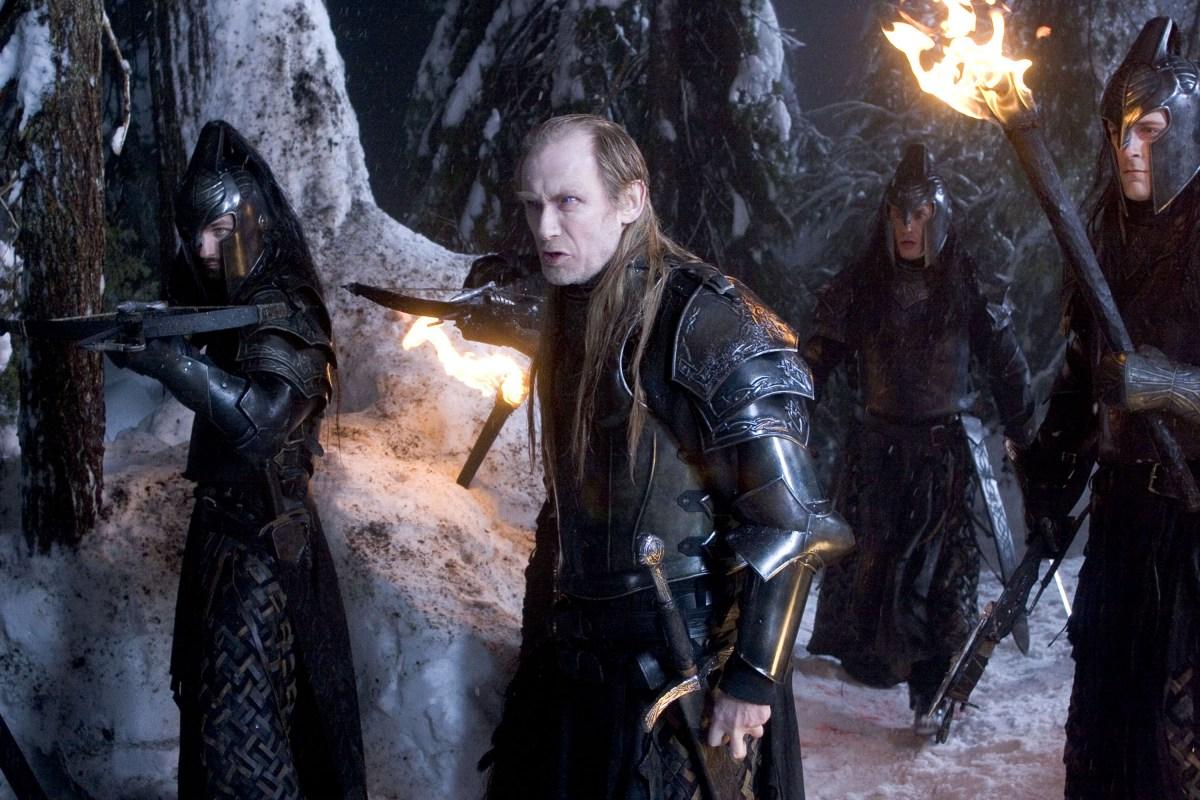
Overall, the cinematography is breathtaking. There is a scene where Hogwarts teachers perform enchantment spells to protect the school against the evil invaders. Statues of armored knights come alive and leap into position. A vast ethereal scrim is unleashed to cover the school. It’s a powerful, emotionally charged scene with great special effects. Indeed, the entire movie is a visual feast.
Throughout the eight Harry Potter films, movie goers have grown up with the young characters. Here, Harry and his friends are finally adults. I loved the quick glimpses of Ron and Hermione's long-time friendship turning into romance. The young trio do justice to Rowling’s idea of the brave, intrepid schoolmates in search of justice.
The real hero has to be the unlikely Neville Longbottom who stands up to the onslaught of Voldemort’s legions near the end of the movie. He risks his life to confront what he believes is a dark obstacle to the truth. Stirring stuff!
It’s always fun to see England’s most esteemed actors taking part in the films. Once again, we meet Michael Gambon as Dumbledore, beloved headmaster of Hogwarts (his character is dead but comes back in an other-worldly scene with Harry at the very end of the movie), Helena Bonham Carter is the over-the-top evil Belatrix Lestrange, the wonderful Maggie Smith as Professor McGonagall and larger-than-life Robbie Coltrane as Hagrid.
The actor who demands the most respect for this film, however, is Alan Rickman as the mysterious Professor Severus Snape. Throughout Harry Potter’s journey, Snape has been both friend and foe to Harry. In the final movie, we finally understand what makes Snape tick. The trip back in time thanks to the pensieve (an object used to retrieve memories) gives Harry a look at the real Snape. This was the most moving part of the film where the film viewer finally understands the depth of Snape’s love for Harry’s mother Lily and the sacrifices Snape has undergone to honor that love and protect Harry.
In the end, this film shows the grand battle between good and evil played out on the school grounds of Hogwarts. Although Voldemort seems all-powerful, his comeuppance is quick and powerfully done. Favorite characters die; others are injured. Somehow, though, the resourcefulness and integrity of Harry and his friends shine through.
Stats:
Theater location: Heritage Cinemas in Sandwich, Friday, July 29, 6:30 p.m. Price: $9.50.
Movie date with hubby Greg. No snack.
Albert was never meant to be King. He was shy, retiring and had that awful stammer. He was the younger of the two brothers and everyone knows that the philandering older brother, Edward, should have been King.
In The King's Speech, Edward (Guy Pearce) comes across as a playboy who would rather be off playing with his friends, drinking, smoking cigarettes and chasing the love of his life, an American divorcee. Meanwhile, dependable, likable Albert (Colin Firth) stays home in the palace with his beautiful wife, the Duchess of York (Helena Bonham Carter) and their two daughters (the oldest little girl will eventually become Queen Elizabeth).
A flashback shows Albert (known as Bertie) at his father’s deathbed, trying to say goodbye. Bertie stammers and becomes flustered, at which point his dying father sits up in bed and bellows at him to stop stammering and learn how to speak. It becomes achingly clear that Bertie has had an unhappy childhood. Even his own brother calls him “b-b-b-b-Bertiie.”
Bertie’s wife helps him find a speech therapist, Lionel Logue (Geoffrey Rush), an eccentric Australian who, upon meeting Bertie, asks him what he would like to be called. Bertie replies, “You may call me Your Royal Highness,” to which Lionel answers, “I’ll call you Bertie.” Thus begins a lifelong struggle to improve Bertie’s speech as well as a long and happy friendship between the two men which goes on for the rest of their lives.
The acting in The King's Speech is superb. Colin Firth and Geoffrey Rush play off of each other with just the right amount of pizazz. Some of the funniest moments in the film are when Lionel has Bertie doing all kinds of acrobatics and histrionics to help him relax, and thus help him speak without stuttering.
When Lionel visits the palace for the first time, he is surrounded by luxury in an enormous room with one elegant chair placed in the center. As Lionel is about to sit down on it, Bertie jumps to attention, grabs Lionel and shouts, “Only Kings can sit in that chair.” Lionel continues to dance around the chair, trying to sit down, while Bertie struggles to keep him out of it. “No other person has ever sat in it,” Bertie says, “only Kings.” When Lionel finally succeeds in pushing Bertie out of the way and sits down, he gloats at Bertie as if to say, “I’ve won this round.”
This is, indeed, a great movie. I recommend it to everyone, young and old. And here lies my one criticism. Because of one short scene where Lionel has Bertie shouting the F-word like a rapid fire machine gun as fast and as loud and as long as he can keep it up, the film is rated R. If only he had used the D-word (duck) or the L-word (luck), then it would have been a perfect family film. Children would enjoy it and learn some history in the process.
I hope Hollywood takes note of the kinds of films millions of people want to see.
(Editor's note: A PG-13 version was recently released in a limited run. So, I think they took Muriel's recommendation to heart. Also, look for the movie on DVD and Blu-Ray on April 19th.)
The Illusionist is an animated film concerning an aging magician trying to continue his line of work as the 1960’s start to blossom and leave him behind, a dusty relic of pre-television and rock band days.
The story is taken from an unproduced Jaques Tati script and the animators have modeled the magician, M. Tatischeff, rather straightforwardly on Tati himself, Tatischeff being Tati's original surname. Tati’s physicality was his signature in his own films when he played a character called M. Hulot in Mon Oncle, and Mr. Hulot’s Holiday among others. Tati was a tall man who gave his Hulot persona pants that were a touch too short and a strange, forward-tilting gait that lent a crazy momentum to his walk. He often seemed like he was trying to keep balance on a listing ship though he was standing on terra firma.
Tatischeff lists about, waiting in the wings of shabby music halls for more popular acts to end, stuffing his irascible rabbit back into its magic hat. When he is fired from his steady gig in France, he travels to a small island in Scotland where his act is well received. While there he is befriended by a young girl who is enchanted by the magician’s ability to materialize coins from thin air.
His gig done, he heads back to the mainland. On the ferry ride he finds the girl from the island has made herself his companion and he does not rebuff her. He secures a gig in a music hall in Edinburgh and they room in a shabby hotel full of other dated acts including 3 very energetic acrobats, a genteel ventriloquist and a depressed clown.
The illustrations that make up the backgrounds and interiors of the movie are stunning works of art, take-your-breath-away watercolors in motion.
Many standard cinematic methods are employed; a view of the city as if photographed from a crane, wide panning shots that sweep across landscapes and give you a sense of scale.
The people are rendered in the exaggerated style I loved in the director’s previous animated film, The Triplets of Belleville, moving caricatures, often ugly but never uninteresting.
From The Triplets of Belleville
While the movie feels so strongly its Tati origins, (the magician even briefly happens into a movie house showing a Tati movie at one point, a touching nod to the creator) I found the tone decidedly un-Tati-like. In Mr. Hulot’s Holiday Tati plays a clueless nice guy who inadvertently creates small havoc around him in a seaside resort. People who crave order are offended by him, free spirits and children are delighted by him. In Mon Oncle he is the favorite uncle of a small boy being brought up in an ultra modern, antiseptic house with all the latest electronic amenities but no warmth or comfort. Hulot is a welcome bit of chaos in his nephew’s ordered world. And at the same time, Tati is gently poking fun at the changing world around him.
In The Illusionist, the world is changing around Tatischeff, but this doesn’t present him with a chance to make mischief. It depresses him that no-one wants to see his act anymore, and the people who do show are not impressed. For this magician, the changing times force him to find work so he can continue to produce coins out of thin air for the little girl who is growing into a young woman who wants things like dresses and shoes.
There are moments of slapstick, many brought on by the aforementioned rabbit, and in one scene he attempts to wash a car, a job for which he is wholly unqualified, while he moonlights in a garage. But these scenes lack the humor, the joy, the childish mischief of a Tati film. The overall feeling is instead one of beautiful, poignant, melancholy.
I don’t think anyone in the packed theater was prepared for that. When the movie ended, an older gentleman behind us exclaimed “That was depressing! Makes me wanna go home and take poison!” While I was left with a less anguished response, I did need some time to compose myself before emerging into sunlight. And I’m glad we stayed to the end of the credits because there was a tiny little joke there which helped lighten our moods.